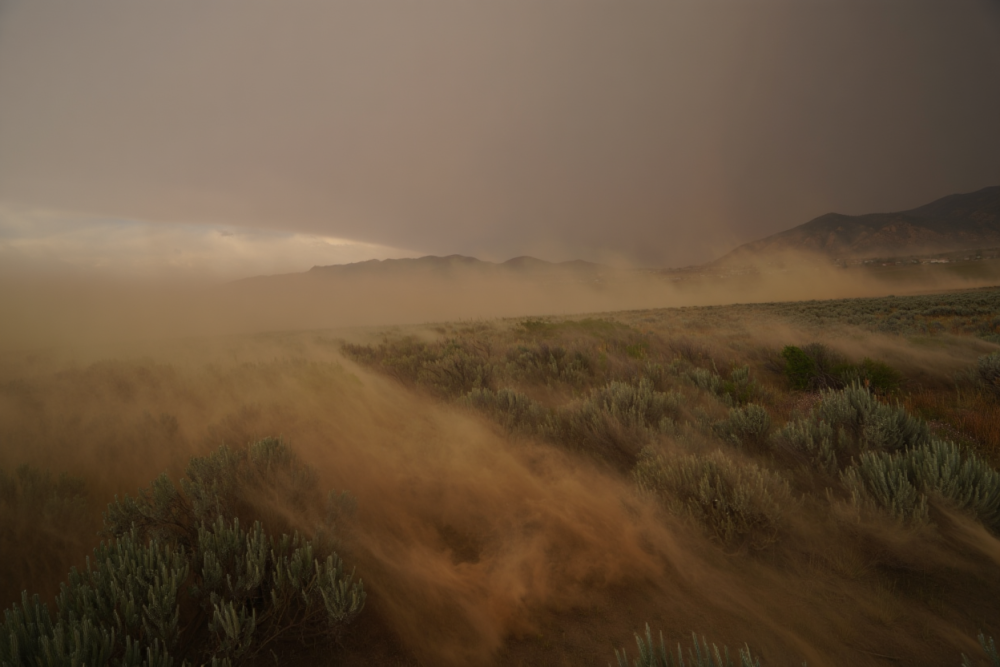
A dust storm in Oklahoma is a severe weather event involving strong, turbulent winds and large amounts of loose dust and dirt. The National Environmental Satellite, Data, and Information Service (NESDIS) of the National Oceanic and Atmospheric Administration (NOAA) defines a dust storm as: “a wall of dust and debris that is blown into an area by strong winds from thunderstorms.” This wall of dust can be several thousand feet high and reach miles in length.
Is Oklahoma Known for Dust Storms?
In the U.S., dust storms are most common in the Southwest, which is where Oklahoma is located. Springtime, i.e., from around February to April, are when dust storms proliferate, thanks to the region’s dry soil, little plant cover, and high wind conditions.
Oklahoma, especially its Panhandle region, is particularly famous for dust storms. The state’s Panhandle region was part of the Dust Bowl, which was a devastating disaster that occurred in the 1930s. While the Sooner State still experiences dust storms today, these are less severe than the historic Dust Bowl.
The Dust Bowl
The Dust Bowl was an environmental disaster of immense scale that devastated the Great Plains in the 1930s. It was characterized by massive dust storms, relentless winds, and intense drought. The dust storms were unrelenting, with some lasting days and months on end.
While historians and scientists describe the Dust Bowl as a constantly shifting phenomenon, meaning severe drought and the worst dust storms did not stay fixed in one place, it primarily affected an area of 300,000 square miles in Oklahoma, Texas, western Kansas, eastern Colorado, and New Mexico. This area is widely considered to be the heart of the Dust Bowl, but local level dust storms became more common throughout the plains.
Also known as the “Dirty Thirties,” the Dust Bowl lasted for about a decade. The southern Great Plains and the Midwest were hit by a severe drought in 1930, which prepared the ground for the massive dust storms that began in 1931. These dust storms were worsened by a series of drought years that followed.
Also making the environmental disaster worse was the rapid loss of topsoil brought about by over-farming. An estimated 160 million acres of land had become useless for farming and/or was rapidly losing its topsoil by 1934.
Fortunately, the end of the decade also brought a close to the Dust Bowl years. In 1939, the region’s parched land once again tasted regular rainfall. However, the effects of the Dust Bowl would linger on well into the 1950s.
Why Was It Called the ‘Dust Bowl’?
The Dust Bowl got its name from Robert E. Geiger, a reporter for the Associated Press. His use of the term in his articles is considered to be the first-ever use of the phrase.
“Residents of the southwestern dust bowl marked up another black duster today…,” he wrote in Lubbock Evening Journal. “Three little words… rule life in the dust bowl of the continent – ‘if it rains’,” he wrote in another article.
What Caused the Dust Bowl?
The Dust Bowl was caused by three main factors: changes in regional weather, prolonged drought, and poor farming techniques. Other economic and cultural factors also came into play, including federal land policies.
- Regional weather
While dry conditions and high winds are common to the region, the 1930s was characterized by unusually hot and dry weather. According to the Oklahoma Historical Society, “The dry weather began in the early 1930s and persisted through the early 1940s for some areas….”
- Prolonged drought
The 1930s was also hit by a severe drought. It started in 1931 and persisted throughout the decade before finally ending in 1939 when regular rainfall returned to the region.
- Federal land policies
The U.S. government encouraged the settlement of land and incentivized farming in the Great Plains after the Civil War through a series of federal land acts. These include the Homestead Act of 1862, the Kinkaid Act of 1904, and the Enlarged Homestead Act of 1909. As a result, millions of people moved west. The new settlers had diverse backgrounds, with some having farming knowledge or experience and others novices looking for a fresh start. Both, however, lacked the specialized farming knowledge necessary for the region.
In addition, it was a common belief at the time that “rain follows the plow.” In other words, they believed that by working the land, they could make the Great Plains conducive to farming.
- Wheat demand and prices
A couple decades prior to the Dust Bowl saw the prices of wheat rise. In addition, World War I increased the demand for wheat in Europe. As a result, there was a rush to plant wheat, corn, and other row crops in the Great Plains. Millions of acres were plowed up for the purpose.
However, wheat prices dropped at the onset of the Great Depression. In an attempt to break even, farmers in the region plowed through more grassland to plant bumper crops. But, a decade-long series of severe drought would hit the region starting in 1931, leaving eroding soil at the mercy of high winds.
- Poor farming practices
The prairies of the Great Plains act as a natural protective carpet, which hold moisture in the soil and keep it from blowing away. When homesteaders arrived, they dug up millions of acres of grasslands. The removal of native grasses, deep plowing, and other poor farming practices exposed the soil to the region’s high winds. Plus, overgrazing and mechanized farming during and after World War I only worsened the damage.
So, when the drought started in the early 1930s, there was neither grass nor crops to hold down the dirt. As a result, the topsoil became susceptible to wind erosion and dust storms became common in the area during the period.
What Were the Consequences of the Dust Bowl?
Residents had to deal with dust, which banked against their houses and farm buildings like snow. These needed to be cleared with shovels. Dirt covered everything and seeped into everything. It clogged the vital parts of automobile engines and, through cracks and crevices, found their way inside homes where they coated skin, food, and furniture.
Dust pneumonia caused chest pains and difficulty breathing. The choking dust left people outside their homes disoriented and occasionally suffocated.
The Dust Bowl caused a significant agricultural failure too. Crops failed across the entire region, with agriculture virtually ceasing in the hardest-hit areas. Flying dust cut off crops or tore out their roots. It also shifted dirt from one field to another.
Animals died because there weren’t enough crops to feed them. Even if they tried to eat grass, these were laden with dust and filled their stomachs with fatal mud balls.
With no crops or animals to sell, farmers lost their farms and homes to banks, food became expensive, and people had no jobs. Food prices went up, and people lost all their savings. Desperate for work and better living conditions, many farm families went west toward California. More than 350,000 people were reportedly on this “Okie migration.”
Soil erosion was also a huge issue. Dust storms, especially black blizzards, took dirt from the Great Plains and blew them all the way east to Washington, DC and the East Coast. These even coated ships in the Atlantic Ocean with dust.
Severe dust storms called black blizzards formed billowing dust of clouds. They were so named for their propensity to blot out the sun, turning day into night, sometimes for days at a time.
Fortunately, at least one good thing came out of the Dust Bowl. It prompted long-term governmental responses on agricultural reform and soil conservation, which was a new field at the time. It also became the subject of famous songs like Dusty Old Dust by singer-songwriter Woody Guthrie, the novel The Grapes of Wrath by John Steinbeck, photographs, and paintings.